
AI in Manufacturing: What Maintenance Teams Need to Know in 2026
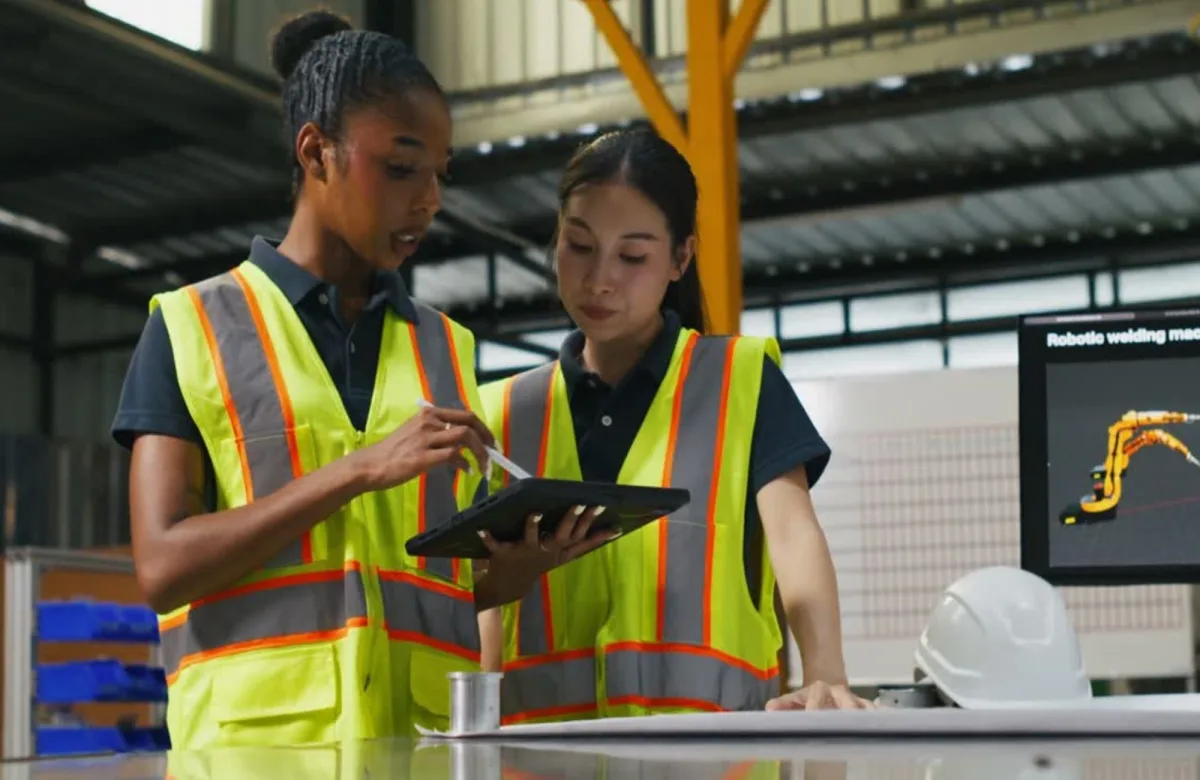
AI in manufacturing uses technologies such as machine learning, computer vision, predictive analytics, and generative AI to analyze data, identify patterns, predict potential problems, and support decisions across plant operations. For maintenance teams, its most practical uses include detecting unusual equipment behavior, prioritizing inspections, supporting troubleshooting, improving quality control, and organizing approved technical information. AI can support the work, but it does not replace technician judgment, safe work practices, or established maintenance procedures.
For Operations VPs and L&D Directors, the priority is not simply adopting another AI tool. It is preparing your workforce to understand what the system is showing them, verify recommendations against equipment conditions, and use the technology within your facility’s safety, quality, and reliability requirements.
To prepare your team for AI in manufacturing, start with the maintenance work your technicians perform today and the decisions AI may help them make tomorrow.
What Does AI in Manufacturing Actually Mean?
Artificial intelligence in manufacturing refers to systems that analyze data, recognize patterns, make predictions, generate content, or recommend actions that support manufacturing operations. Unlike conventional automation, which follows defined rules and sequences, AI models can identify relationships in large or changing data sets.
That distinction matters on the plant floor. A programmable logic controller can execute a defined control sequence. An AI-powered system may analyze vibration trends, process temperatures, motor current, work-order history, and production data to flag equipment that may require attention before a failure occurs.
AI for manufacturing is not one technology or one product. It includes several capabilities that can serve different parts of the manufacturing process.
| Technology / Capability | Practical Manufacturing Application | Maintenance Team Role |
|---|---|---|
| Machine learning | Detecting patterns in sensor, quality, and historical maintenance data | Check the condition, confirm the fault, and determine the corrective action |
| Predictive analytics | Identifying equipment or components that may be at higher risk of failure | Prioritize inspections and planned work based on risk and operating context |
| Computer vision | Detecting visible defects, missing components, or abnormal conditions | Verify alerts and maintain cameras, lighting, guarding, and supporting equipment |
| Generative AI | Summarizing approved work orders or locating relevant procedures | Review outputs against controlled documentation and site procedures |
| Digital twins | Modeling equipment, processes, or production changes before implementation | Provide equipment knowledge and validate model assumptions |
| AI-supported planning | Forecasting demand, inventory needs, capacity constraints, or production schedules | Communicate equipment availability, maintenance windows, and constraints |
The National Institute of Standards and Technology’s AI for Manufacturing initiative focuses on reliable human-AI teaming, operator understanding, interoperability, and fit-for-purpose evaluation. That reflects a practical reality: an AI tool has value only when people can interpret it correctly and apply it within the actual conditions of the facility.
For manufacturers evaluating where AI can support maintenance and operations, an AI readiness framework can help connect technology adoption with workforce skills, data practices, and operational readiness.
Where AI Is Used on the Plant Floor
AI in manufacturing is already supporting specific operational decisions. The strongest use cases begin with a defined problem, usable data, and a clear human decision-maker.
Predictive Maintenance and Equipment Reliability
Machine learning for predictive maintenance uses data from equipment condition, operations, and maintenance history to identify patterns that may indicate developing problems. Inputs may include vibration, temperature, pressure, flow, motor current, oil analysis, acoustic data, alarm history, and work orders.
For example, an AI model may flag a centrifugal pump because vibration at a particular frequency has increased under similar operating conditions. That alert is not a diagnosis by itself. A technician still needs to inspect the pump, review process conditions, take confirmatory readings, and determine whether the issue is misalignment, imbalance, bearing wear, cavitation, looseness, or another cause.
This is where machine learning for predictive maintenance becomes useful: it can help maintenance planners focus limited inspection and maintenance time on the equipment and conditions that deserve closer attention. It does not eliminate the need for route-based inspections, troubleshooting fundamentals, or a sound preventive maintenance program.
Quality Control and Computer Vision
AI-powered computer vision can analyze images or video to identify surface defects, incorrect labels, incomplete assemblies, missing parts, or other quality conditions. It can support faster and more consistent screening on a production line, particularly when an inspection task is repetitive or high-volume.
However, computer vision depends on disciplined setup and upkeep. Changes in lighting, camera position, product presentation, material finish, or contamination on a lens can affect results. Maintenance personnel may need to maintain the physical system while quality and engineering teams define acceptance criteria and investigate exceptions.
Production Planning and Supply Chain Management
AI tools can support production planning by analyzing historical sales data, inventory levels, supplier information, production schedules, capacity constraints, and real-time data. This can help planners consider possible responses to demand changes or supply chain disruptions.
Maintenance has an important role in this work. A production schedule is only realistic when it accounts for equipment availability, planned shutdowns, known reliability risks, spare-parts lead times, and the time required to complete maintenance correctly. AI-supported planning should improve communication between operations and maintenance, not encourage teams to defer necessary work.
Generative AI for Technical Information
Generative AI can help users search, summarize, organize, or draft information. In a manufacturing setting, it may help a technician locate an approved troubleshooting guide, summarize recurring fault descriptions from work orders, or turn structured maintenance notes into a clearer handoff for the next shift.
It should not become an uncontrolled source of maintenance instructions. Generated answers can be incomplete, outdated, or wrong. Your facility should define which documents are approved sources, what information may be entered into AI tools, who reviews outputs, and when controlled procedures take precedence.
Digital Twins and Process Improvement
A digital twin is a digital representation of a physical asset, process, or system that can be used to analyze or simulate operating conditions. In manufacturing, digital twins may support layout changes, capacity planning, process adjustments, energy analysis, or scenario modeling before a change is made on the factory floor.
NIST describes digital twins for advanced manufacturing as part of its work to support manufacturing interoperability and data-driven systems. For maintenance teams, the value comes from contributing accurate equipment knowledge: operating limits, failure modes, maintenance history, process interactions, and the conditions that affect asset performance.
What AI Does Not Replace
AI can analyze data quickly, but it cannot assume responsibility for safe work or independently account for every physical condition and site-specific variable affecting a machine.
Your technicians still need to:
-
Follow approved maintenance procedures and energy-control requirements.
-
Inspect equipment and obtain reliable measurements.
-
Read schematics, drawings, alarm histories, and controlled documentation.
-
Distinguish a useful AI alert from a false positive, incomplete recommendation, or data-quality issue.
-
Escalate decisions that affect process safety, quality, production, or equipment integrity.
-
Document the findings, repair, and follow-up work needed to improve the maintenance program.
AI does not change the requirement to control hazardous energy before covered servicing and maintenance work. OSHA’s lockout/tagout standard continues to apply based on the work being performed, not on whether an AI system identified the need for that work.
The Skills Maintenance Teams Need to Work Alongside AI
The technician of the future still needs strong mechanical, electrical, hydraulic, pneumatic, and troubleshooting skills. AI adds another layer: the ability to use data-supported recommendations without treating them as automatic answers.
Foundational Technical Skills Still Come First
AI outputs are only as useful as the technician’s ability to connect them to the equipment. A model may identify an anomaly, but a technician needs to know what normal operation looks and sounds like, how the machine is controlled, which process conditions matter, and which failure modes are plausible.
Training should continue to build competence in:
-
Mechanical power transmission, bearings, lubrication, alignment, and vibration fundamentals.
-
Electrical systems, motors, controls, sensors, drives, and schematic reading.
-
Hydraulics, pneumatics, process instrumentation, and control systems.
-
Systematic troubleshooting and root-cause thinking.
-
Safe work practices, energy control, and facility-specific procedures.
Data and AI Literacy
Technicians do not need to become data scientists. They do need enough AI literacy to ask informed questions about a recommendation.
A capable maintenance team should be able to ask:
-
What data produced this alert?
-
Is the sensor operating correctly and providing complete data?
-
What equipment condition or operating context does the model assume?
-
Is this a recommendation, a prediction, or a confirmed fault?
-
What inspection or measurement should verify the result?
-
How will the team document whether the recommendation was useful?
This is the difference between using AI as decision support and allowing it to become an unexplained black box.
Documentation and Knowledge Management
AI systems work better when information is accurate, organized, and accessible. Inconsistent asset names, incomplete failure codes, vague work-order descriptions, and uncontrolled documents make it harder to analyze data or learn from past work.
Your organization can improve AI readiness now by standardizing asset hierarchies, failure coding, inspection routes, work-order descriptions, and approved documentation. These practices also improve maintenance planning and reliability even before an AI project begins.
How Manufacturers Should Prepare Their Workforce for AI
An effective AI implementation starts with a workforce and operational readiness plan, not a software purchase.
1. Start With a Defined Operational Problem
Choose a use case tied to a real maintenance or operations need, such as repeated bearing failures, unplanned downtime on a critical asset, slow troubleshooting handoffs, high defect rates, or poor visibility into equipment condition.
Define the current condition first. What is happening? Which assets or processes are affected? What information is already available? Which decision would the AI tool help a person make?
2. Assess Data and Process Readiness
Review the quality of the available data before selecting AI tools. Confirm that sensors are installed correctly, data is time-aligned, asset identities are consistent, and historical work orders provide usable information.
Data quality is not only an IT concern. Technicians, planners, operators, and supervisors all influence the accuracy of maintenance records and the context needed to interpret data.
An AI readiness assessment for your workforce can help your organization identify gaps in skills, process ownership, documentation, data practices, and change management before a pilot begins.
3. Define Human Roles and Decision Rights
Clarify who monitors the tool, who validates recommendations, who can change operating settings, who authorizes maintenance work, and who is accountable for the result. The right answer differs by use case and facility.
NIST’s AI Risk Management Framework provides a voluntary framework organized around governing, mapping, measuring, and managing AI risks. For manufacturers, this can translate into practical questions about data access, cybersecurity, output review, traceability, and escalation when the system produces an uncertain or incorrect result.
4. Train by Role, Not With One Generic AI Course
Operations leaders need to understand business goals, risk, governance, and performance measures. Maintenance managers need to connect use cases to asset strategy, maintenance workflows, and technician development. Technicians need practical instruction on interpreting alerts, verifying outputs, recording findings, and following approved procedures.
Role-based training makes AI adoption more useful because each person learns how the technology affects the work they actually perform.
5. Pilot, Measure, and Improve
Begin with a limited, measurable use case. Track both operational and workforce outcomes, such as inspection completion, alert verification rate, repeat failures, troubleshooting time, unnecessary part replacements, and technician confidence with the workflow.
Do not judge a pilot only by whether the model produces an alert. Review whether the alert helped the team make a better maintenance or operational decision.
At this point, you can prepare your team for AI in manufacturing by connecting the pilot to a structured training plan, defined roles, and realistic performance measures.
A Practical Readiness Checklist for Maintenance Leaders
Before implementing AI in manufacturing, confirm that your facility can answer “yes” to most of the following questions:
-
We have identified a specific maintenance, quality, or operations problem worth solving.
-
We know which decisions AI will support and which decisions remain human responsibilities.
-
Our equipment, sensor, production, and work-order data are reliable enough for the intended use.
-
Technicians and supervisors can access the approved documentation needed to verify AI outputs.
-
We have defined safety, cybersecurity, privacy, and change-control requirements.
-
We have a process for testing recommendations before acting on them.
-
We will measure operational results and workforce adoption, not just software activity.
-
We have a plan to train operators, technicians, planners, supervisors, and leaders by role.
-
We have identified how lessons from the pilot will update procedures, training, and maintenance strategy.
Training Pathways for an AI-Ready Workforce
AI readiness is not a separate replacement for maintenance training. It is an extension of the technical foundation your workforce needs to operate and maintain increasingly connected systems.
For organizations, the most effective path usually combines foundational skilled-trades instruction, cross-training in controls and data-informed troubleshooting, and emerging-technology education for the roles affected by new tools. ITC Learning’s emerging technologies course library can support broader workforce development as your facility prepares technicians and leaders for technology changes.
For individual technicians, AI creates another reason to strengthen the fundamentals. If you can read a schematic, understand a sensor signal, recognize equipment behavior, and troubleshoot systematically, you are better positioned to evaluate AI recommendations instead of relying on them blindly. Those skills remain valuable in smart factories, traditional plants, apprenticeships, and career pathways across the manufacturing industry.
AI in Manufacturing Works Best as Human-AI Teaming
The goal of AI in manufacturing is not to remove people from maintenance decisions. It is to give your workforce better visibility into equipment conditions, production processes, and recurring problems so they can act with better information.
Manufacturing USA notes that workforce development must account for emerging careers involving robotics, automation, AI, and data analytics, alongside upskilling the current workforce. Its manufacturing workforce development initiative reflects the central challenge for manufacturers: technology adoption and workforce capability must advance together.
When your technicians understand both the equipment and the limits of the AI tools supporting them, your facility is in a stronger position to improve reliability, quality, safety, and operational efficiency. Prepare your team for AI in manufacturing with a workforce plan that treats AI as a practical tool within a disciplined maintenance program.
Why Organizations Choose ITC Learning
-
50+ years developing skilled-trades training
-
1M+ learners trained
-
175+ courses · 450+ lessons
-
SCORM-compliant · Deliverable via ITC LMS or your existing platform
-
Available in English and Spanish
-
Supports manufacturers, industrial employers, educational institutions, workforce development programs, apprenticeships, and CTE partnerships