
Apprenticeship vs. Internship: What’s the Difference (for Organizations Evaluating Workforce Models)
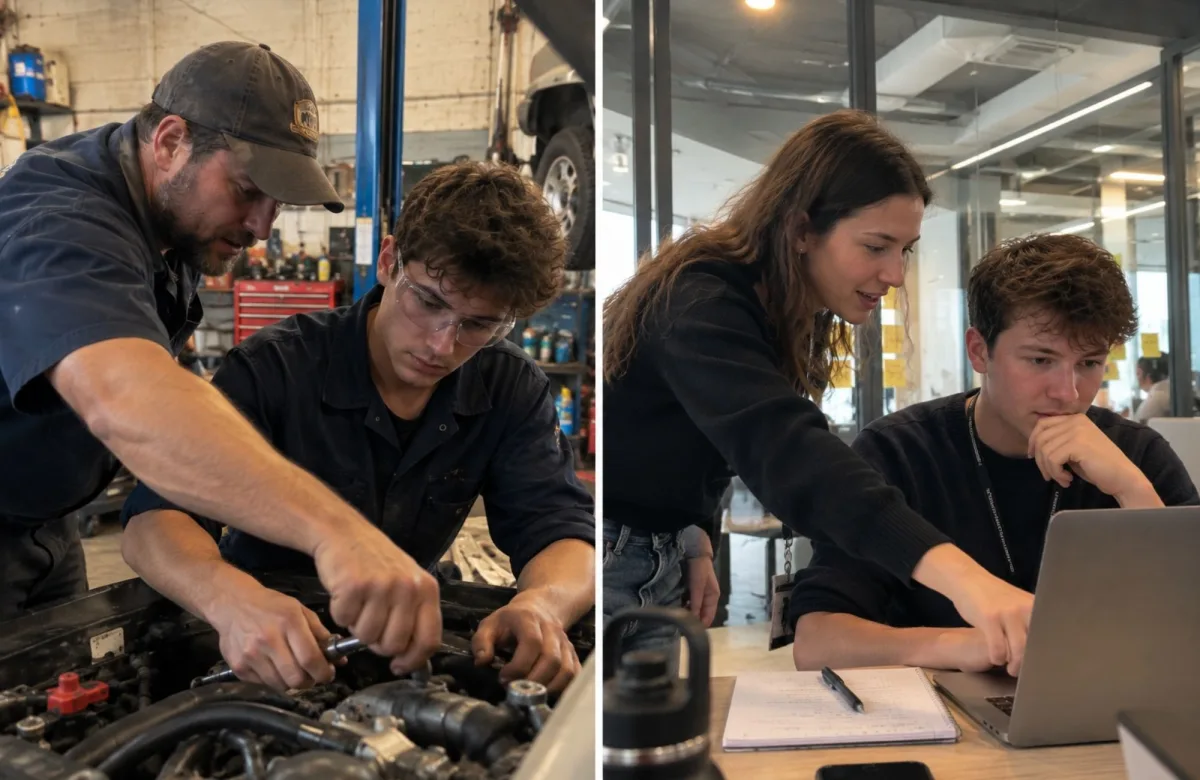
An apprenticeship develops workers for a defined occupation through paid employment, structured on-the-job learning, mentorship, and related instruction. An internship usually gives participants shorter-term exposure to a workplace, role, or set of projects. For your organization, the choice depends on the outcome you need: occupational competency over time or a shorter opportunity to explore work and gain experience.
The right model also depends on how much training, supervision, and progress tracking your organization can support.
Apprenticeship vs. Internship at a Glance
The U.S. Department of Labor’s comparison of apprenticeships and internships describes general differences in structure, duration, pay, and credentials.
| Program feature | Apprenticeship | Internship |
|---|---|---|
| Primary purpose | Develop competency in a particular occupation | Provide experience with a workplace, role, or field |
| Typical duration | Longer term; length depends on the occupation and program | Often shorter term, such as a summer or academic term |
| Work and instruction | Planned on-the-job learning paired with related instruction | Supervised work, observation, or projects; formal instruction varies |
| Mentorship | An ongoing part of the training plan | Depends on the program’s design |
| Pay | Registered Apprenticeships are paid jobs and include progressive wage increases. Other apprenticeship arrangements should be described according to their actual employment and compensation structure. | Internships may be paid; whether an unpaid arrangement is lawful depends on its circumstances |
| Credential or outcome | An apprenticeship may lead to an industry-recognized credential; a Registered Apprenticeship leads to a portable, nationally recognized credential. | Usually documented work experience; college credit may be available through an educational partner |
| Common organizational use | Building a sustained pipeline for an occupation | Offering short-term exposure or a defined project experience |
If you’re building an apprenticeship, distinguish your program’s structure and credentials from those of a Registered Apprenticeship. Registration carries specific requirements and leads to a nationally recognized credential.
What Is an Apprenticeship?
An apprenticeship is a structured approach to developing someone for a specific occupation while they work. Your organization identifies the skills required for the role, arranges supervised opportunities to practice them, and pairs that work with related technical instruction. Progress is measured against the training plan rather than attendance alone.
For an industrial maintenance apprenticeship, that plan might move from print reading and basic electrical or mechanical concepts to supervised equipment tasks and more complex troubleshooting. The sequence gives instructors and mentors a shared view of what an apprentice has learned, what they have practiced, and what they are ready to do next.
A Registered Apprenticeship Program has formal requirements. The Department of Labor’s guide to creating a Registered Apprenticeship Program identifies paid employment with wage progression, structured on-the-job learning and mentorship, supplemental instruction, and a portable credential among its components. A program sponsor is responsible for its design and operation. Organizations considering registration should review the occupation and work with the relevant apprenticeship office or State Apprenticeship Agency.
What Is an Internship?
An internship gives a participant experience in a work environment, usually for a shorter period and with a narrower set of assignments. An industrial employer might offer an internship that includes observing maintenance planning meetings, learning how work orders are documented, or completing a defined reliability data project under supervision.
An internship can be useful and well structured. It can include a mentor, learning goals, feedback, and practical projects. Those features do not, on their own, make it an apprenticeship. Internships vary widely in structure, so organizations should describe the actual work, supervision, compensation, and expected outcome rather than rely on the program label alone.
If your organization is considering an unpaid internship at a for-profit business, review the arrangement carefully. The Department of Labor’s guidance on internship programs under the Fair Labor Standards Act explains the primary beneficiary test used to assess whether an intern or student is an employee. A program’s name, the possibility of college credit, or a short duration does not settle that question. State requirements may also apply.
The Difference in an Industrial Maintenance Setting
Suppose your facility needs more people who can maintain motors, pumps, and control systems. An internship and an apprenticeship could both introduce participants to that work, but they would serve different purposes.
An internship might give a participant a defined project: review completed work orders, help organize equipment records, and observe how technicians investigate recurring faults. The participant gains context about the work environment, while your team gains support on a supervised project.
An apprenticeship would require a broader development plan tied to the maintenance occupation. An apprentice might study motor fundamentals, practice reading electrical drawings, observe an experienced technician, and complete progressively more demanding tasks under supervision. The organization would document both related instruction and on-the-job progress.
In either model, access to equipment and hazardous tasks must follow your facility’s procedures and applicable safety requirements.
For example, OSHA’s hazardous-energy standard sets training requirements according to an employee’s role in the energy-control program. Completing an online lesson or passing a knowledge assessment does not, by itself, establish that someone is authorized to perform lockout/tagout or qualified for a particular maintenance task.
Which Workforce Model Fits Your Organization?
Start with the capability your organization needs to develop. A short project and a defined occupational pathway call for different levels of instruction, supervision, and measurement.
Choose an Apprenticeship for a Defined Occupational Need
An apprenticeship is a stronger fit when your organization has recurring demand for a specific skilled role and can support development over time. Before starting, identify:
-
The occupation and tasks. What work must a person eventually perform, and which tasks require separate safety training or authorization?
-
The training sequence. Which technical concepts should come before supervised practice?
-
Mentor capacity. Who can teach, observe work, give feedback, and document progress?
-
Related instruction. Who will provide the technical education that supports learning at work?
-
Progress measures. How will you distinguish course completion, technical knowledge, observed performance, and program completion?
This planning matters in industrial roles because exposure to a task is not the same as competency. A technician may understand a pump diagram yet still need supervised practice before completing an inspection or repair to your facility’s standard.
Choose an Internship for a Short, Defined Experience
An internship may fit when your organization can offer a useful project or supervised exposure but does not need an occupation-wide training pathway. Define the assignment, the supervisor, the learning goals, and what the participant can reasonably complete within the available time.
For example, a utilities organization might work with an educational partner on a summer project to organize asset information or examine maintenance records. That project can introduce participants to the industry without presenting the experience as preparation for independent technical work.
Pay and the nature of the work need attention during program design. If participants are performing work for a for-profit employer, assess the arrangement under applicable wage and hour rules before treating it as an unpaid educational experience.
Consider How the Models Could Work Together
An internship can help a workforce organization or educational partner introduce participants to industrial work before they commit to an occupation. An apprenticeship can then provide the longer, structured path to develop competence in that occupation.
For instance, a participant might first complete a supervised workplace project that introduces maintenance scheduling and equipment documentation. If the occupation is a good fit and an apprenticeship place is available, the participant could enter a separate program with its own paid employment, training plan, instruction, and completion requirements. Moving from one model to the other should be an intentional program decision, not an automatic promise.
How to Measure Whether the Program Is Working
Use measures that match the model’s purpose. Counting participants or hours alone will not tell you whether your organization met its workforce goal.
| If you run an internship, review… | If you run an apprenticeship, review… |
|---|---|
| Completion of the agreed project | Progress against the occupational training plan |
| Quality of supervision and feedback | Completion of related instruction |
| Participant understanding of the work environment | Demonstrated skills in supervised work |
| Whether the experience helped inform next steps | Mentor feedback and documented progression |
| Feedback from the host team and educational partner | Retention, program completion, and documented task sign-offs |
Keep technical knowledge separate from practical capability. A course post-test checks what someone understands after completing that course. A standalone skills assessment identifies existing knowledge gaps before training. Neither shows, on its own, that someone can perform a task safely. Use supervised demonstrations, work observations, and task sign-offs as separate evidence of practical performance.
This distinction helps your organization see where instruction is complete but supervised practice is still needed. Your employer or program sponsor must decide what evidence is required before assigning a task or recording an apprenticeship milestone.
Supporting the Technical Instruction in an Apprenticeship
An apprenticeship needs technical instruction that connects to the occupation and reinforces learning at work. For a maintenance pathway, that may include electrical theory, print reading, motors, mechanical systems, instrumentation, and troubleshooting concepts. Instructors and mentors can then connect those concepts to the equipment and procedures used at your facility.
ITC Learning’s apprenticeship training can support the online technical instruction portion of a program through courses, learning paths, course post-tests, and progress tracking. Standalone skills assessments can identify existing knowledge gaps before training begins. Your sponsor remains responsible for deciding how the courses fit its related instruction plan and for meeting applicable program requirements. Online instruction must also be paired with the supervision and practical evaluation required for the work.
If your immediate need is to develop employees already in a role, workforce development and upskilling may be a more direct starting point than creating either an internship or a new apprenticeship. The right model follows the workforce need you have defined.
Explore Apprenticeship Training for Your Workforce Program
If your organization needs a sustained pathway into industrial maintenance or another skilled occupation, begin with the work participants must eventually perform. From there, map the related instruction, supervised practice, mentor responsibilities, and evidence of progress.
Explore Apprenticeship Training to see how ITC Learning’s technical courses and learning paths can support the instruction within your program.
Why Organizations Choose ITC Learning
ITC Learning supports organizations that need consistent technical education across roles, cohorts, and locations.
Training resources include:
-
50+ years developing skilled-trades training
-
1M+ learners trained
-
175+ courses · 450+ lessons
-
SCORM-compliant · Deliverable via ITC LMS or your existing platform
-
Available in English and Spanish
-
Supports manufacturers, industrial employers, educational institutions, workforce development programs, apprenticeships, and CTE partnerships
These resources can support a program’s technical instruction and knowledge tracking. The organization running the program remains responsible for workplace supervision, practical evaluation, safety procedures, and applicable apprenticeship requirements.